01 / Case study
Canon AMLOS
Designing the experience for a product that didn’t quite exist yet.
- Client
- Canon U.S.A. · AMLOS camera system
- Role
- Lead UX Designer & User Researcher
02 / The technology
One room. One camera. Four people looking at different things.
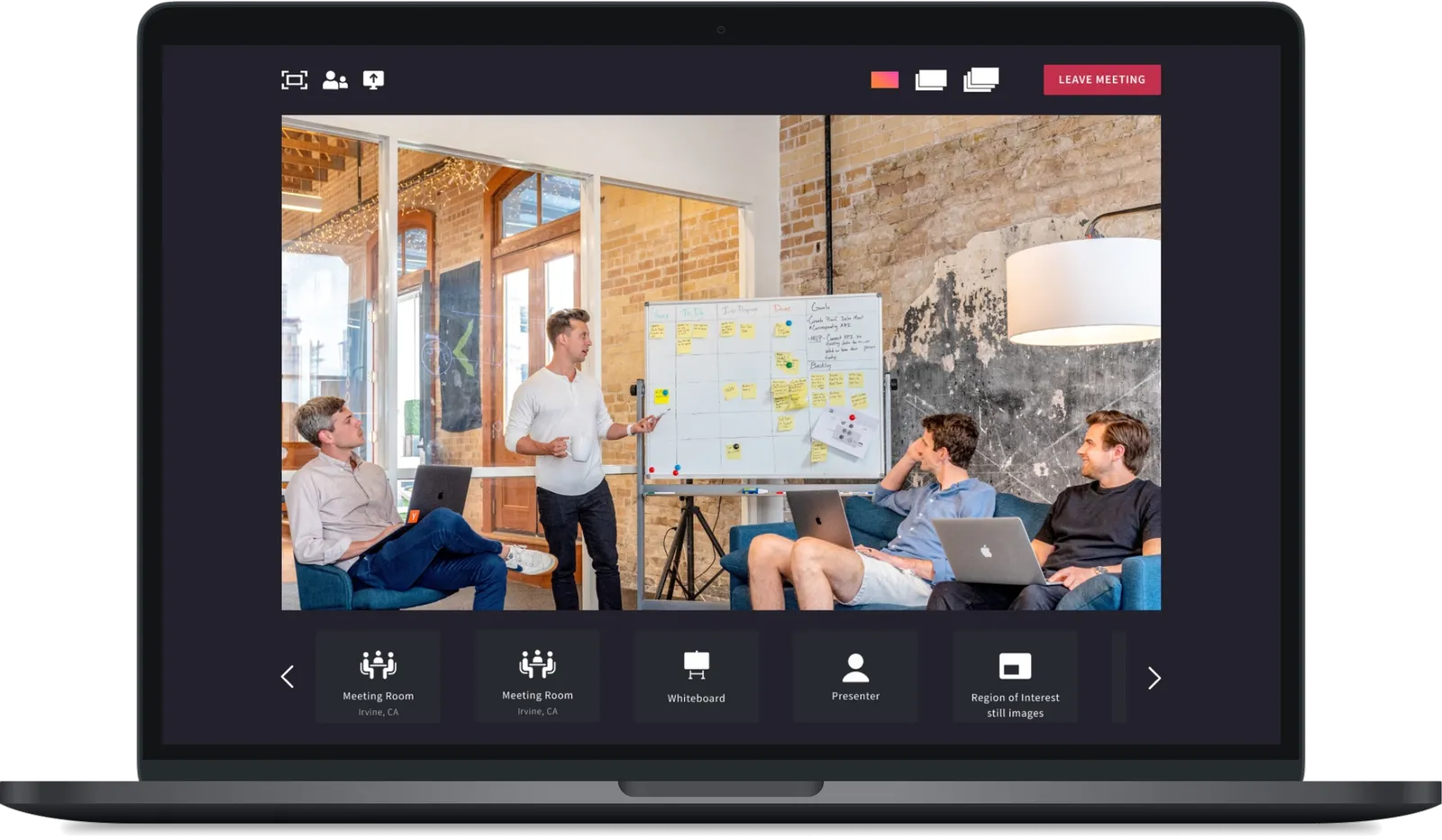
AMLOS — Activate My Line of Sight — lets several remote participants independently control what they see of a physical room, all from a single Canon PTZ camera with enough resolution to be cropped into many times over.
One room, one camera
- Remote AThe presenter
- Remote BThe whiteboard
- Remote CThe wider room
- Remote DOne object, close
03 / The question
The technology worked.The bigger question was how people should actually use it.
There was no pattern to borrow. This wasn’t a redesign of a mature product with conventions to clean up — the hardware, the software and the experience were being defined at the same time, and every decision had to satisfy three things at once.
01
What people need
To look where their attention goes, without running a camera while trying to attend a meeting.
02
What the technology can do
Pan, tilt, zoom, high-resolution capture and image processing, from a single PTZ camera.
03
What can actually be built
Hardware, software and experience were being defined at the same time, so nothing was settled.
My job sat in the middle of those three, which is the only place the product could come from.
04 / What we had to learn
Start with people. Not the camera.
Research and design ran together rather than in phases: what we learned shaped what we built, and what we built gave us something new to put in front of people. These were the questions we kept returning to.
- 01Where do people naturally want to look during a meeting?
- 02What gets lost when you are the person who isn’t in the room?
- 03How much control do remote participants actually want?
- 04When does controlling the camera stop helping and become another job?
- 05How much should belong to the presenter, and how much to the person watching?
- 06Which interactions feel obvious without anyone explaining them?
05 / Experiments
The ideas that didn’t survive.
Prototypes had to go out before every technical detail was settled, which meant finding out early where an obvious-sounding idea fell apart. These three changed the product most.
01
The idea
Give remote participants real camera control
What happened
Driving a camera turned out to be a job. People stopped following the meeting and started operating equipment.
Choose a view, don’t steer a camera
02
The idea
Let the person in the room direct attention through software
What happened
Stopping a conversation to operate an app broke the very thing the product was meant to protect.
Gestures, so directing attention stays part of talking
03
The idea
Expose everything the camera is capable of
What happened
Technically impressive did not mean useful. More capability on screen made the room harder to read.
Only the capabilities that made the experience better
06 / The product
Control, without controls.
What shipped doesn’t look like a camera-control interface, and that is the point. A remote participant picks from views that already make sense — the room, the whiteboard, the presenter, a detail worth looking at — rather than driving hardware.
The path from a capability to that interaction model wasn’t a straight line, but it was a deliberate one.
- Technical capability
- User behavior
- Research
- Experimentation
- Interaction model
- Product

07 / In the wild
Out of the lab.
AMLOS moved past research prototypes into a released Canon product in 2022, and onto the show floor. At CES 2022 Canon demonstrated it with HITRECORD, Joseph Gordon-Levitt’s collaborative platform, with remote contributors following whiteboarding inside the room. At CES 2023 it went further, connecting people in Las Vegas to a film set in Philadelphia for M. Night Shyamalan’s Knock at the Cabin.
The demonstrations pushed the idea to an extreme. The interaction underneath stayed the same.
- Concept
- Prototype
- Product
- CES
Recognition
- CESBest of Innovation2023
- InfoCommBest of Show2022
- InfoCommBest of Show2020
- ProductionHUBAward of Excellence2022
Looking back
Sometimes the job is helping a team understand what a new piece of technology is actually for — then giving people a way to use it that feels obvious.